Tuesday, 29 April 2014

Mission: Impossible III

Mission: Impossible III (2006)

Starring Tom Cruise and Philip Seymour Hoffman

Directed by J.J. Abrams


Straight away it's worth saying that this is popcorn multiplex cinema at its purest.  Although it bears no resemblance to the TV series episodes, which week in and out consisted of complex con schemes, in which the team would use their array of disguises and tricks to sidetrack and confound their nemeses, the films have been primarily focused on action.  Of which, this episode delivers in spades. With J.J. Abrams being the talk of the town at present, having directed two "Star Trek" films, and with "Star Wars: Episode 7" on its way, I think it's worth re-visiting his directorial debut, another franchise-reviving effort.  Following the overly convoluted first installment (inexcusable that - Spoiler alert - they made Jim Phelps a villain) , and the overblown "M:I 2" this episode pumps a shot of adrenaline into the series.


Chiefly, "M:I 3" is superbly entertaining.  I liked Cruise at the start of his career; around the "Jerry McGuire" era, I started to find him extremely annoying, but around about the time of "Minority Report" (2002) he went on a really good run of films, and I gradually came to like him again.  He's certainly immensely charismatic in this movie.  Recently married (to Michelle Monaghan's character) Hunt genuinely has something to fight for, and to lose, and this gives the film an added punch. Michelle is great as the wife who slowly comes to realise that there is more to her husband than she first thought, and comes into genuine danger towards the film's climax (incidentally kicking some serious ass along the way - go girl!).  As one would expect from a film in this series, the globe is well and truly crossed, from Washington to Rome, eventually to a beautifully shot Shanghai (predating "Skyfall" but looking no less wonderful.).  I believe that this was the first Western production to be allowed to film in China.


Perhaps unlike previous installments, the rest of Hunt's "Impossible Missions Force" team are suitably likeable too.  Ving Rhames returns as Luther, Ethan's right-hand man, and a stalwart of the series.  The gorgeous Maggie Q ("Live Free or Die Hard") joins in the fun, and the team is rounded out by Jonathan Rhys-Myers (aka Henry VIII) as the team's helicopter pilot.  There's even a small role for Simon Pegg as Benji, an IT alayst at the IMF (not the International Monetary Fund!)  The antagonist, Owen Davian, is magnificently played by the late, great Philip Seymour Hoffman.  He brings a chilling nastiness to the character, posing both a physical and mental threat to our hero, and is easily one of the best cinema villains of recent times.  Support is offered by Billy Crudup, Musgrave, and as the team's overall boss, Brassel, a snarling Laurence Fishburne.  The great Eddie Marsan also crops up as one of Davian's henchmen.  The plot revolves around Davian's attempts to obtain something called the"Rabbit's Foot".  This a Macguffin of the highest order, as it is never explained as to what it is; presumably it's some sort of virus or chemical weapon.  Along the way we get TV's "Felicity", kidnappings, daring rescue attempts, message-containing microdots, the obligatory self-destructing message, a  Lamborghini being blown up, Hunt using a mask to impersonate Davian, a traitor in the agency, our hero becoming a fugitive and, for good measure, a fair bit of fighting and explosive action.


It's all pretty standard stuff for a film like this in a genre like this, nothing new, in other words. It feels like something we've seen a hundred times before, but not quite. It's almost as if the set-pieces have been given a slight tweak, so they feel a little more original. For example, a helicopter chase takes place not just over, but also through a giant wind-farm, leading the audience to fear and / or expect one of the helicopters to be hit by a huge rotating propeller. A missile attack at one point takes place on what seems to be the longest bridge / causeway in the world - I presume it's the Florida Keys. Narratively we see from the very first scene Hunt, captured by Davian, tied to a chair and his wife with a gun to her head, so the film is essentially 85% flashback. We know where he ends up, but it's enjoyable finding out how he got there. Hunt seems more interesting this time round, probably due to his emotional involvement - in addition to his romantic situation, early in the film a character he's close to and trained up, is killed off, so he's trying to keep a lid on the grief from that.


Abrams' direction is impressive.  For sure there is a measure of "Shaky-cam", and quick cutting, but the action is always coherent.  Although he was an experienced operator in the TV world at the time, as a feature debut, charged with reviging a high-profile franchise, no less, this is strong work.  It's by a long chalk the best of the M:I films.  It's not a guilty pleasure, there's nothing about which to be guilty.  It's a well put together piece of fluffy entertainment, but does exactly what it sets out to do.  Mission: Accomplished.

Wednesday, 23 April 2014

The Informant!


The Informant! (2009)

Starring Matt Damon and Scott Bakula

Directed by Steven Soderbergh


So it's another collaboration between Matt Damon and Steven Soderbergh.  With a script by Soderbergh regular Scott Z Burns, based on the book by Kurt Eichenwald "The Informant! A True Story", it's the omission of that second part which very much colours the audience's expectation coming into this film.  I haven't read the book or searched for news articles yet so I have no idea how closely it sticks to the "True Story" but after seeing the film I will definitely do so.  I've read elsewhere that the real-life protagonist has said that the film is "very accurate".  Certainly it's a story which takes so many twists and turns, going in so many directions all at once, that if you didn't know it was based on events which actually transpired, you'd think the writer was just crazy. 


Another Soderbergh regular, Matt Damon, plays Mark Whitacre, a high level executive at ADM, a chemical company based in Decator, Illinois.  ADM produces lysine, a corn-based additive, which as he explains at the start of the film, turns up in almost everything we eat.  ADM is encountering production problems and suffering financially as a result.  Whitacre tells his superiors that the plant is being sabotaged by a contact he met briefly in Japan, and claims he has been called with a $10,000,000 blackmail demand.  The FBI, in the shape of Agents Brian Shepard (Scott Bakula) and Bob Herndon (Joel McHale) are called in to tap Mark's phone, so as to capture any future calls.  But Mark subsequently retracts his initial claim and says the whole thing is part of a price-fixing conspiracy among competing international lysine producers and that the phone was tapped by ADM itself.  Thus begins a jet-setting adventure in which Mark, having agreed to become an informant, travels the world attempting to record or otherwise gain evidence of the conspiracy, which seemingly involves American, French, and Asian firms amongst others.  Along the line he changes his story once more, saying that the meetings are about controlling volume levels rather than price fixing.  There are further twists and turns to Whitacre's version of the story along the way, a period of more than two years, which is increasingly frustrating for the agents.  Each time they have to confront Mark and ask if he's told them everything, and pleading with him to keep his mouth shut, you can see their doubts grow. As the case progresses, and Whitacre leaks the fact of an impending raid on ADM, it comes to light that he's been taking kickbacks to the tune of millions...


The film is essentially touted as a whacky, knockabout comedy.  There are certainly many incidences of off-kilter humour, most notably in the "jet set" scenes, in which Mark seems to think of himself as a James Bond type figure; "Mark Whitacre, secret agent 0014"  "Why 0014??"  "Cause I'm twice as smart as 007"!  Also, the voiceovers are priceless.  In the opening scenes, he explains - somewhat manically - about the links between corn, corn syrup, lysine, and the food we eat every day.  This is all good, because it's relevant to the main thrust of the movie.  But as it goes on, they get more and more random.  "I like my hands" he muses.  "That metric system never panned out".  "There should be a TV show about a guy who calls homeone day, and he's there, he answers, he's talking to himself, only he's someone else." !!!  Some of them are just so left-field that they're hysterical.  Over all, there's a dry, wry sense of humour threaded throughout the film.  I can understand why broader audiences wouldn't "get it", but if you can plug into the tone, it's fantastic.  But things are essentially much, much darker.


Amongst the main themes of the film are Corporate / White Collar crime, lying and deception, fraud,  betrayal, self-delusion, illegal surveillance, and ultimately, mental illness.  It's to his immense credit, and evidence of his masterful skills of direction, that Soderbergh manages to balance such grim elements with light comedy.  The film's score is notably up-beat and jaunty, as if purposefully to counteract the brooding subject matter.  It's almost fit for a cartoon.  But I never found it jarring.  It certainly does a huge amount to affect the film's tone and mood.  Underlying the whole of the proceedings is sense of the utterly absurd.  The conspiracy, whether it be price fixing, volume fixing, something else, or even if there's a conspiracy anywhere other than Whitacre's mind is absurd.  Mark's erratic behaviour and skittish mindset are almost past the threshold of credibility.  Yet it happened.


This is a supremely unusual, but deeply memorable film.  Distinct in tone and content, I found it successful on almost every level.  But I can see how another viewer might find it impenetrable, abstract, or just too odd.  The balance of humour and drama is incredibly delicate, and whilst I think Soderbergh pulls it off with aplomb, others might feel one fatally outweighs the other.  Damon is predictably strong in the central role, capturing the instability - and mania - of the increasingly deluded protagonist.  Scott Bakula too is sterling in support as the sadly resigned G-man, who comes to realise that the prize he thought he had won isn't there.  There's a wide-ranging supporting cast, containing many unfamiliar faces, but a few familiar ones, such as "30 Rock"'s Scott Adsit, Melanie Lynsky ("Heavenly Creatures"), Clancy Brown, Patton Oswalt, and Biff Tannen himself, Tom Wilson.  One really has to think, however, that the film belongs to the real-life Mark Whitacre.  A poignant coda shows him 10 years down the line, balding, physically degraded but still deluded.  It's a fitting conclusion to a unique and notable story.


SB

Saturday, 19 April 2014

Rush

Rush (2013)

Starring Chris Hemsworth and Daniel Bruhl

Directed by Ron Howard


Ron Howard is an odd film-maker. On the one hand he can put out films which are breath-takingly good, of which I count this one, "Apollo 13" another, and so on. Yet he can also churn out stuff that is groaningly bad, say the "DaVinci Code" and its sequel, or "The Dilemma". This film falls squarely into the former category, his direction being solid, unflashy and unobtrusive.  He tells the extraordinary true story of the 1976 Formula 1 racing season, one of the closest in history; in particular it focuses on the relationship between the two best drivers of the time, Austrian Niki Lauda, and Britain's James Hunt.  Both men were risk-takers who raced hard, but that's just about where  the similarity ends.  Lauda is shown to be serious and stern off the track, working brilliantly with his teams' engineers to heighten the speed and performance of the cars.  Hunt, on the other hand was a total playboy, partying it up as hard as he raced, living it up to a lifestyle of booze and birds.


Don't be put off if you're not a fan of, or know nothing about Formula 1, because like the recent documentary "Senna", this is a story of humans and emotions.  Written by Peter Morgan (who seems to specialize in two-handed human drama, having "The Queen", "Frost / Nixon" etc under his belt) the writing is solid and evokes the passion, even if sometimes a little "Basil Exposition", for the uninitiated. The racing sequences are superb nonetheless - brilliantly shot by Anthony dod Mantle ("Slumdog Millionaire") and edited by Bafta winning Dan Hanley and Mike Hill (Howard regulars). They're nail-bitingly exciting, well choreographed and staged, in one instance absolutely terrifying, truly a reminder of how dangerous racing was back then.  In one scene Lauda matter-of-factly accepts this, saying "Yes, I know, I could die every time I get in my car".  He undergoes a terrible trauma during the season, interestingly after a pre-race drivers meeting in which the drivers debate whether the weather conditions make it safe to race.  Hunt goads him into letting the race go ahead, and the worst happens.  Lauda shows his physical and mental strength to fight his way back into the car - some of this is painful to watch, certainly not for the squeamish.  But it sets up a remarkably tense and tight finish to the season (I won't spoil it for you)


In their roles as, respectively Hunt and Lauda, Chris Hemsworth (he of "Thor" fame) and Daniel Bruhl ("Inglorious Basterds") are both superb.  It's a shame that there have been so many impressive performances this year as I'm sure at any other time they both would have been certainties for awards.  Their physical resemblances to the real life man is a bonus, but it's just good casting.  It's down to the actors themselves to deliver, and here they certainly do.  Also notable in smaller roles are Olivia Wilde as Hunt's wife Suzy Miller and Alexandra Maria Lara as Marlene Lauda.  And it was amusing to see Stephen Mangan crop up in a cameo as a nechanic.  Furthermore there's one other character worth mentioning: the sound.  In the racing scenes the sound of the powerful engines pumping and speeding away, rolling through the gears brings the film to life in a quite remarkable manner.


So this is powerful stuff, exciting, emotional, technically flawless and expertly played.  Arguably a period piece, the sense of time and place are well and truly evoked.  I really enjoyed it and found it to be one of the best films of the year.  I saw it on a double-bill with "Gravity".  What a strange experience that was!


SB

Monday, 14 April 2014

Ice Cold in Alex

Ice Cold in Alex (1958)

Starring John Mills, Anthony Quayle, Sylvia Simms and Harry Andrews

Directed by J. Lee Thompson


Set in 1943 in North Africa at the height of the Second World War, and based on the novel by Christopher Landon, the film follows the crew of an Ambulance, nick-named Katy, heading from Tobruk towards the hospital in Alexandria, carrying a pair of nurses.  Led by Captain Anson, played with typically dependable stoicism by the great John Mills, the crew faces a variety of tribulations on their journey.  Anson is a recovering alcoholic, and clearly under huge pressure.  Mills' performance is  a triumph, as he struggles to keep a lid on his internal turmoil.  The title refers to a cold beer he has promised himself when they eventually reach Alexandria.  The crew is rounded out by Sylvia Simms as nurse Sister Diana Murdoch, Anthony Quayle as South African officer Captain van der Poel, and the ever-reliable Harry Andrews as M.S.M Tom Pugh.  This is a very tight and striking four hander; it's a cast to die for, and the performances are uniformly strong.  It's the first time I've included more than two stars at the header for this piece, because it really is impossible to separate the four of them.  One of the best ensemble casts - albeit a small one - ever.  


The plot is by its very nature episodic, but it's engaging and exciting.  It's stirring stuff.  Incidents along the way include frequent mechanical problems with the old ambulance, a perilous trip through a soft-sanded region, a desperate attempt to make it up a steep slope of a sandy hill, attacks by Stuka dive-bombers, a nerve-jangling minefield crossing, and encounters with German troops in the region - van der Poel is a German speaker and twice manages to secure the crew's freedom to press onwards.  He's very macho, somewhat aloof, but big and strong, and proves to save the team on several occasions.  But midway through the film, the rest of the crew begin to have suspicions that something is amiss, and that he's not entirely what he claims to be.  But they need to stick together to stay alive, even though the seeds of discord have been sown.  It means that they need to place their faith in him despite their doubts.  It adds to the power that makes this film more than just an adventure story, but a brilliant human drama.  There's a hint of romance between Simms and Mills, but it's never over-played.  There's one moment, and only one, where Mills explodes with rage and frustration.  It's brilliantly played, utterly believable, and only serves to highlight the control and leadership he otherwise shows.


Technically, the film is second to none, particularly given when it was produced, and the type of pictures which proliferated at the time.  Shot in stark black and white, the cinematography is outstanding, crisp and clear.  The directing choices are memorable too.  In particular, Thompson deploys a technique whereby he contrasts the stark desert landscapes in wide, wide shots, the ambulance appearing as a tiny creature in the wilderness, with tight, claustrophobic moments in the back of the ambulance, featuring an abundance of close-ups.  Pace-wise, the film is not typical of the average WW2 drama / adventure.  Whilst the plot constantly feels like it's moving forward, some scenes are incredibly drawn out for reasons of tension - in particular the minefield cross, and the sandy hill climb.  This makes the film stand out from many others in the same genre.  The score is full of bombastic Military march style music very reminiscent of the period, but another thing to make the film memorable is that for long periods it is soundless, perhaps in reference to the desolate nature of the surroundings.  Characters will simply interact without speaking, or, for instance, a dying character will whisper so softly that we can't hear anything, and the soundtrack doesn't offer up sweeping emotional music.


At the climax, for which I don't feel obliged to say this a spoiler, the crew arrive in Alexandria and head to the bar to partake in the aforementioned ice cold beer.  Anson orders the barman to line them up, and there follows a fantastic moment of silent reflection, as he stares at the glass, with an almost sexual lustre.  After everything they've been through, they made it, and this is his prize.  He contemplates the glass, and traces his finger down its condensated side.  It's one of the many moments that make this film iconic, in the truest sense of the word.  I believe it was even used as a beer advert in the 1980s!  There's a brilliant, tense moment in this scene involving van der Poel's dog-tags, but I'll let you see the movie for yourself and enjoy the moment - not exactly a "twist", but close to one.


It's fair to say that this is a bona fide classic in just about every sense of the word.  It's one of the best Second World War films ever made, it's one of the best adventure / "guys on a mission" films ever made, it's one of the most hauntingly beautiful films ever made, and one of the best character pieces ever done.  Little details stand out... such as the beads of sweat on Sylvia Simms' cheeks in one scene, or indeed a moment when she will just look at another character and offer up a wistful smile.  Whether you're interested in the adventure or the characters, "Ice Cold in Alex" will prove to be one of the most rewarding and memorable filmic experiences you have.  Expertly directed by J. Lee Thompson, who did the original "Cape Fear" with Robert Mitchum, and a couple of "Planet of the Apes" movies, the film is remarkably solid and enjoyable.  Cannot rate highly enough.


SB

Her

Her (2013)

Starring Joaquin Pheonix and (the voice of) Scarlett Johansson

Directed  by Spike Jonze


This is such an unusual film, but I suppose you couldn't expect anything else from Spike Jonze, perpetrator of the insanely bonkers "Being John Malkovich" ("Loved you in that jewel thief movie" !)

Joaquin Pheonix stars as Theodore Twombly, an impending divorcee who specialises in working for a website for which he writes letters for people who can't channel their feelings adequately.  In a sense, he's a filter for other peoples' emotions and as such at the start of the film, he's rather blank, despite going through an intense emotional experience with his divorce. Purchasing a new Operating System for his computer and phone, a talking Artificial Intelligence named Samantha, Theodore's perception of feeling and love is gradually turned upside down. Rarely has an actor or actress so thoroughly carried a film on their own.  Pheonix appears in virtually every scene (maybe every one), and gives a frankly brilliant performance.  There are multiple versions of the poster internationally.  Most consist of an extreme close up of Joaquin's face, sporting a manly moustache, however the one included above, possibly does more to convey Theodore's sense isolation as depicted in the movie.  Crucially, Theodore develops as a character, going from rather an emotional cypher, to a person who has learned something about himself, love, relationships and the world.  To use the cliché, he's been on "a journey", something essential to all drama. 


 Essentially this is a two-hander, although there are others in the supporting cast notably Amy Adams in another good showing after "American Hustle", so it's vital that the actress giving voice to Samantha is up to the task, and Scarlett Johansson certainly is that.  It's a performance which blends equal measures of curious, sensual, and robotic flatness.  It must be difficult to present an articulate performance without being able to employ physicality; think, for instance, about how much actors such as Al Pacino rely on their body language to portray their characters.  Spare a thought, though, for Samantha Morton - herself a fantastic actress - who voiced the character during filming, but was subsequently replaced.


This is by far one of Jonze's two best films (Malkovich being the other and not including music videos for the likes of R.E.M, The Chemical Brothers, and  The Beastie Boys); it's certainly streets ahead of uneven fare such as "Where the Wild Things Are" - which was interesting but inconsistent.  In addition to the strong performances from the actors, the Production Design is wondrous and the Cinematography, by Swiss D-P Hoyte van Hoytema (how's that for a name?!), who also shot "Tinker Tailor Soldier Spy", "The Fighter" and "Let the Right One In", is stylish and graceful, as one would expect given the look of the aforementioned films.  There's an almost permanent air of twilight (not "Twilight"!) and deep haunting.  The script, written by Jonze, is smart and subtle.  Many themes abound; primarily love, lonliness and the need for companionship, emotional intelligence, artificial intelligence, and more.  Without wishing to drop a spoiler (Sweetie!), there's a revelation towards the climax which evokes matter-of-fact coldness from one of the protagonists and crushing devastation for the other.


Furthermore, Jonze's Direction is measured; the movie is much more level-headed than some of his previous work, perfectly paced and utterly absorbing throughout.  And I had no idea exactly where it was going, so it was a pleasant surprise to find out.  The premise could arguably deemed "Science Fitction"; certainly the concept of AI raises that spectre.  Ultimately though, it's just an off-beat, intriguing, brilliantly made, highly original movie.  I love cinema, and am generally well-disposed towards a picture and keen to enjoy it.  That doesn't always happen, of course, but in this instance, I think "Her" is a truly great film, and I'm sure that when I come back to it in future I'll find deeper and deeper levels.  It's been a great year for Cinema, with the likes of "Rush", "Gravity", "The Wolf of Wall Street", "American Hustle", "Walter Mitty", so on and so forth, I can heartily endorse "Her" as being right up there with the best of them.

SB 
Wednesday, 2 April 2014

American Hustle

American Hustle (2013)

Starring Christian Bale and Amy Adams

Directed by David O. Russell


The film begins with an ironic title-card: "Some of this actually happened". Which in itself is much more honest than the oft-used "Inspired by true events" or suchlike, when one knows most of the script is made-up. Certainly the film is based on the Abscam operation carried out by the FBI in the late 70s, but one suspects a fair amount of dramatic license has been taken - after all "Argo" was full of factual inaccuracies which played up the drama. For the better.


Overall, this is an epic movie about HAIR. The opening scene shows Christian Bale's character (Irving Rosenfeld) painstakingly applying an outrageous toupee to his balding head. Bradley Cooper chips in with his Ruud Hullit style curly, greasy afro-curls. And there's Jennifer Lawrence's blonde dye-job. Leaving that aside there's a story about two con-artists, busted by the FBI, being forced into trying to take down a seemingly corrupt New Jersey Mayor - the suitably bouffanted Jeremy Renner, on top form as Carmine Polito (adding to the wild hair count). Hair and costume, and music (the soundtrack is excellent), play a huge part in setting the scene within period - for this is a period piece for sure. The film plays wildly with the audience's emotions; at different points in the story each character gains our sympathy, and at other moments loses it. The four leads - although Christian Bale and Amy Adams take the true lead roles, with Bradley Cooper and Jennifer Lawrence ("the Picasso of passive-aggressive Karate") in close support - all turn in superb performances, as evidenced by their Oscar nominations. The movie was unlucky to come away from the Academy Awards empty-handed. I found it a much more absorbing watch than the big winner "Twelve Years a Slave", which whilst extremely powerful - and horrific - may have benefited a vote or two from the worthiness of its subject matter rather than the quality of the finished film.  Still - horses for courses.


Set in New York City in 1978, Bale, as Irving, is a relatively small time con man, who teams with Adams' scheming Sydney, channeling Lady Penelope, who pretends to be a member of the British royalty with influential banking connections in London, to scam a string of clients desperate for cash, who will pay a down fee on a larger loan to pay off their debts, but who never receive their money. The plan to entrap Mayor Carmine involves bringing in a "fake Sheik" (they should have worked for The Sun) who promises to invest millions in the New Jersey economy to re-develop the Atlantic City casino strip, and enticing him to take bribes. But the viewer is conflicted, as Carmine clearly states that everything he does is for the benefit of his community, and he only has them at heart. Later in the film Irving clearly has doubts about selling out the man he has come to consider his friend, with whose family he has often socialised which further adds to the moral ambiguity of the picture. 


Cooper, as the increasingly obsessed FBI agent Richie DiMaso (there's a scene in which he assaults his boss!), is fast becoming one of my favourite actors following his work in "Limitless" and Russell's "Silver Linings Playbook". Having heard him interviewed a few times he seems like a really decent chap to boot. Amy Adams on a fine run of form - she was one of the best things about "Man of Steel", she's in type in "Her"; I have been a big fan of hers since seeing hers "Doubt" a few years back. The likes of Louis C.K fast bring up the rear of quality in this cast. As for Jennifer Lawrence, it's much more satisfying to see her taking on roles like this, "Silver Linings" or "Winter's Bone" rather than the "Hunger Games" roles, as she is a fantastic actress. Then again, there has been a long history of actors carrying and carrying out careers which span big-budget blockbuster nonsense one minute then smaller Indie pictures the next.  It can be done.


Oddly it brings to mind a modern day version of "The Sting". But it's so rooted in its era that it doesn't achieve the same timelessness of the older film. There's a lot thrown into the mix here and I can understand why some might think it messy.  In addition to the main scam plot and the main characters' distrust of each other, there's also a simmering sexual tension between the four, and their gradual unraveling, in particular the bitter and slightly left-field relationship between the two female leads as they compete for the affections of Irving.  What is it about him that attracts a woman like this? It seems he just has "it".  Confidence.  David O. Russell's films arguably aren't always the most accessible, but if you can buy into the tone this movie sets it's absorbing and rewarding.

SB

Saturday, 22 March 2014

Phantom

Phantom (2013)

Starring Ed Harris and David Duchovny

Directed by Todd Robinson


"Phantom" is by no means a perfect movie but it is a very well made, effective, and entertaining one. And it's Independent.  The setup is simple; an about-to-retire Soviet Submarine Commander is sent out on one last mission in his old boat, some "special" operatives join him with their own hidden agenda and a top secret cloaking device... Is their intention to defect, or to launch a first nuclear strike against the US? Our captain suspects the latter.


The film certainly plays on, or fits neatly into, depending on your point of view, the traditional tropes of both Cold War thrillers and Submarine movies. The claustrophobia of the vessels generally makes for an extremely atmospheric tension, and this film is no exception. In a way, it's at a bit of a disadvantage because the rules of the genre mean it will immediately be compared to "Run Silent Run Deep" or "The Hunt for Red October". But this isn't to detract from the achievement here. Unassuming, effective direction aside, the real winner in this film is the cast. Ed Harris is simply a superb actor, he's a banker every time and no less effective in embodying his character here than he was in diverse fare varying from "Pollock" to "The Rock" to "The Abyss". David Duchovny is a surprise as the nasty-piece-of-work KGB operative; I've always liked him as an actor ("Return to Me" is an unexpected favourite) and I fear it will be a tag that haunts him for years to come, but here I didn't think about Fox Mulder (one of the all time iconic characters from one of my favourite TV shows ever) or Hank Moody for a second. And particularly, William Fichtner, the supporting actor at the top of any casting director's list, surely, is great as the man torn between loyalty to his captain, duty to the state, and the opportunity for promotion. I can't believe he hasn't been cast as a lead more often. The other supporting cast members were less familiar but also all played well.


It is to be commended, in my opinion, that this was independently made on a fairly tight budget. It just goes to show a good film can be made without a $150 million budget.  In comparison to, say, the ludicrous Tony Scott submarine film "Crimson Tide" it comes out streets ahead.  Sure, there are factual errors here and there, but not that many people would recognize, and the strength of performance and direction win through.

See this movie if you like Cold War or Submarine movies, or are just looking for a slightly offbeat thriller. At just over 90 minutes it doesn't outstay is welcome, and I found the climax to be quite moving. I liked.

Friday, 21 March 2014

The Jokers

The Jokers (1967)

Starring Michael Crawford and Oliver Reed

Directed by Micahel Winner

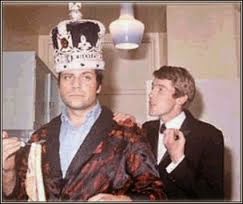
Although he's probably best known now for those "Calm down dear" insurance adverts, in which he appeared before he passed away in 2013, there was one a time when Michael Winner used to make films, most infamously the Charles Bronson vigilante movie "Death Wish" and its two sequels, and one or two were rather good, particularly his comedies of the 60s. His last film, "Parting Shots" was in 1998.  His direction here is vibrant and with a deftness one doesn't normally associate with him. "The Jokers" is a jaunty little caper movie with a wicked sense of humour and an engaging twisty-turny plot. The script, by veteran scribes Dick Clement and Ian La Frenais, whose partnership ranges from "Porridge" and "The Likely Lads" to "The Commitments" and "The Bank Job", by way of uncredited rewrite work on faux Bond film "Never Say Never Again", contains some priceless lines, including a couple which only an Englishman could find funny ("I was in the same house as his newphew.  He was an idiot too... Roger Gurney-Simms.  Went off to Tanganiyka and the bl**dy place became independent as soon as he got there!")

I remember when I was about 5 years old I saw a film about two soldiers (sic) who steal the Crown Jewels from the Tower of London. Latterly, I didn't remember much about it (obviously) or even what it was called, only that I enjoyed it. So I was pleasantly surprised recently, when I stayed to watch the late movie on telly one night and it all came flooding back... Quite why I would have loved "The Jokers" so much when I was five is beyond me, as most of the humour would have probably gone straight over my head. I must have loved the ingenuity of the brothers' scheme and the twists at the closing stages. But then, this movie is so incredibly easy to like - it rattles along at a cracking pace, it looks like a tourist film of London, it's a pleasing thriller, and it's pretty funny to boot. There are many advances in technology which would render crucial details of the plan unworkable today, making the movie very much a product of its times; but baby, what times! The Swinging London of the late 60s, as so affectionately sent up in the "Austin Powers" flicks, is presented here as decadently appealing, if shallow, an endless round of booze and birds. If there's any sour note it is that the "system" which the brothers want to ridicule seems to have been very kind to them along the way. But it's hardly a film to be making profound political statements, so one can't complain. Instead just sit back and enjoy this superbly entertaining little sparkler, as much fun now as it was when I was five years old!


Michael Crawford and Oliver Reed play two brothers, Michael and David Tremayne.  Michael is in the army, whilst David seems to do nothing but womanising his way around the aforementioned Swinging London, dining in fine restaurants, hanging out in nightclubs, and attending parties.  When David plays a prank on Michael which sabotages a training exercise on Salisbury Plain, Michael is drummed out of his regiment.  On his return to London, David suggests that they make "a grand gesture".  After scouting London for suitable targets, they hit upon the idea of stealing the Crown Jewels from the White Tower, but later returning them to the authorities.  The point is not for the robbery to be about profit, but to shock "the establishment" and show up how lax the security is.  They phone in a bogus bomb threat and gain entry to the tower posing as army bomb disposal officers, before staging an explosion and escaping in an ambulance.


The robbery itself occurs relatively early on in the film; the fun part is what happens when the time comes to hand the jewels over.  Double-crossing occurs and the Police desperately try to catch their suspect.  Crucially, at this stage the film keeps its audience guessing, and the outcome is genuinely unexpected (although I have to admit, the final moments are a little silly).  Crawford is charming and funny - although this is no "Condorman"! - whilst Reed is charismatic, if a little gruff.  They are ably supported by, amongst others, Harry Andrews, Michael Horden, Brian Wilde, Warren Mitchell, and Edward Fox.


There's a distinct sense of time and place about "The Jokers".   It's (what I believe is known as) an enjoyable romp.  For a caper movie it's original and memorable.  If you should happen upon it, it's well worth a watch.

Thursday, 20 March 2014

Captain Phillips

Captain Phillips (2013)

Starring Tom Hanks and Barkhad Abdi

Directed by Paul Greengrass

As this film is based on the book (and true story) "A Captain's Duty: Somali Pirates, Navy SEALS, and Dangerous Days at Sea" by Richard Phillips and Stephan Talty, it's fairly safe to say it's no spoiler to reveal that Phillips survives the ordeal depicted in this film.  But the big questions are how did he survive?  What transpired along the way?  Therein lies the glory, and amazing, gripping telling of this film, one of the tensest, most dramatic films that I've seen in a long while.


In 2009, Captain Richard Phillips takes command of the MV Maersk Alabama, a US registered container ship, and sets off on a voyage from Oman in the Middle East down the coast of Africa.  This is the first time he has sailed in this particular ship, so the crew are unfamiliar with his methods, which are somewhat rigourous.  Early in the voyage he notices that the doors and hatches are unsecured, and orders several security drills.   

Meanwhile, in a village in Somalia, Abduwali Muse (Abdi) is ordered by a group of mercenaries working for a warlord named Garaad to go out and find something to provide money for said warlord.  The local young men all clamour for a spot on the mission.

The "pirates" duly close in on the ship, and despite efforts to see them off, they manage to board the cargo vessel.  A tense standoff immediately ensues with Muse telling Phillips "I'm the Captain now" and demanding millions of dollars in ransom.  Phillips has told the crew to hide below decks, barring the crew members serving on the bridge.  He arranges for them to slow the engines, pretending that the ship is crippled, and offers the money from the bridge's safe - $30,000.  This does not satisfy Muse and his band of raiders.


What ensues is an utterly enthralling game of cat and mouse, as the pirates attempt to find the crew, fix the ship, and continue to demand their ransom.  Phillips, for his part, attempts to disrupt their plans, protect his crew, and find a way to freedom.  The brilliance of the film lies in the even-handed treatment of the antagonists and protagonists.  The Somali pirates are shown to be under duress from the warlord, so one can understand their motives for taking such desperate actions.  Morally, it's ambiguous.  But likewise, we can fully sympathise with Phillips' desperate attempts to look after his crew.  With the US Navy fast closing in, the pirates, in frustration, decide to kidnap Phillips and they cast off in one of the ships' lifeboats, setting up a nail-biting final act in which the Captain comes within inches of death.

As one would expect from director Paul Greengrass, pioneer of the documentary-style "shaky cam" look in such films as "United 93" and "The Bourne Supremacy", the film is completely immersive.  It feels at times as though one is a part of the action, or at least as if this is a documentary.  There were some reports on its cinematic release that moviegoers were experiencing sea-sickness due to the camera motion!  It's also extremely exciting and absorbing.

The performances are uniformly superb - Hanks in particular has seldom been better, the final scene, dialogue free, is so, so powerful; and the previously unknown Abdi is wonderful as Muse (deservedly winning a BAFTA award for Best Supporting Actor), but they are also well supported by the ensemble cast of crew members (great to see "Twin Peaks"' Chris Mulkey on board!)

It's emotionally draining - I was stuck to my seat as the end credits rolled - but it's also thrilling, dramatic, skillfully played and directed.  All in all one of the best films I've seen in quite some time.


Tuesday, 11 March 2014

50/50

50/50 (2011)

Starring Joseph Gordon-Levitt and Seth Rogen

Directed by Jonathan Levine


You have cancer.  You're going to die.  You have a massive tumor in your body which will not go away.  It has to be killed by doctors, if they can manage.  They're all politely speculative.  Or you will need life-threatening surgery. Otherwise, it's curtains time.  Think about it.  How do you react?  Are you calm? Are you angry?  Are you sad? Withdrawn? Positive?  Can you even be positive about such a crappy situation?  Do you draw up a bucket list and prepare for the end?  Or are you determined to fight?  How do your friends and family respond?  Are they selflessly supportive? Are they consumed by grief themselves for the perceived outcome?  Are they considerate?  Do they listen?  Are they even aware of your feelings as they struggle to cope with the idea that their loved one (perceived or real) could be coming to the end of their life?  Is their thought about you, or about them?   How do you cope?  Your odds of survival are said to be half in half. Not bad, says your best friend.  Deadly, you think.  These are some of the themes examined in the amazing drama / comedy "50 / 50".  


Joseph Gordon-Levitt, already celebrated for roles in the likes of "Looper" and "The Dark Knight Rises" (Not a word against Ben Affleck but why couldn't JLG have been cast as Batman in the next Superman film?) but who is a certainty to become a *massive* star in future, plays Adam, the cancer sufferer, and Seth Rogen, who has already established his comedic credentials, plays his deeply caring (although it might not often be apparent) best friend Kyle.  This is a story of an ordinary young man, Adam, a polite unassuming, easy-going, journalist for a Public Service radio station, who discovers early on in the film that he has a cancerous growth in his spine, and goes about dealing with that through chemo (evidently), Psych therapy at the hospital, and thinking on life.  It's a beautiful meditation of a picture which touches on all those things mentioned above, and more, without a hint of judgment.  We just see things play out, and are drawn, tremulously, into the human drama of Adam's story.  Adam is in a somewhat unfixed relationship with an artist called Rachael, (not a great artist, at that) who seems unwilling to commit.  He isn't in any way close to his overbearing Mother (Angelica Houston).  His father suffers from Alzheimer's disease and doesn't recognise him each time they meet.  His closest relationship is with his workmate and best buddy (Rogen), although the two are as different as chalk and cheese.  Kyle is loud, lewd and brash, always there with a cheap gag or a one-liner.  Adam is quiet, introspective, withdrawn.  He's the type of guy who will stop at a red pedestrian light whilst jogging, even if it's 6am and there's no traffic on the road.


The main thing to note about this film is that it approaches the cancer as a simple fact.  There's no "Why me?" style angst.  It is what it is, we all have to die eventually.  Sometimes, life sucks.  But sometimes that can make it great.  As the story progresses and Adam comes to terms with his illness, there's a surprising amount of humour.  Most of it comes through his relationship with Kyle, who will, for instance, use a trip to a bookshop to look for books on cancer to pick up the shop assistant, but also through the relationship with a group of fellow chemo sufferers, significantly a pot-smoking group of old men (including Max Headroom himself, Matt Frewer).  It's as much about Adam as it is about those around him - I'd say about half and half...


The power of the film comes from the balance between the two emotional phases of Adam's condition.  For the most part he is cold about it - this is happening, there's nothing I can do, leave me alone.   On the other hand there is a huge amount of humour, and pain all around him.  Having read certain user comments about the movie, they range from "It's outrageous, how do they dare make fun of cancer?" to "I suffered from this, and the movie perfectly nails the gallows humour you experience".  As such, I really bought into it, from the latter perspective.  The movie doesn't make fun of cancer, it simply depicts the way one individual might react to it.  Added into the mix is the tender relationship between Adam and his Psycho-therapist at the Hospital, Katherine, played with immense charm by Anna Kendrick ("Up in the Air", "End of Watch").  She is a rookie, still studying, and Adam is only her third patient - she doesn't have a good survival rate, as he figures out.  There's a great running gag wherein she feels that during sessions it will comfort him if she places a hand on his knee or his arm, but he recoils violently.  She can't figure why, as that's what it says to do in her manuals; he can't understand as it's so obvious he has shields up.  It just injects so much humanity into those scenes. And there's a good Doogie Howser joke.


Without giving wanting to give away anything, the climax of the film is genuinely unexpected, tense, and extremely emotional. "50/50" is an very well made film in my opinion, unfussy but packing a punch.  Although I, thankfully, have no direct experience of cancer, it strikes me as a movie which is true.  It speaks to such a range of emotions - love, sorrow, anger, regret, humour, acceptance - perfectly balanced, that I just loved it.


Oh, and fair played to Joseph for shaving his head on camera!